
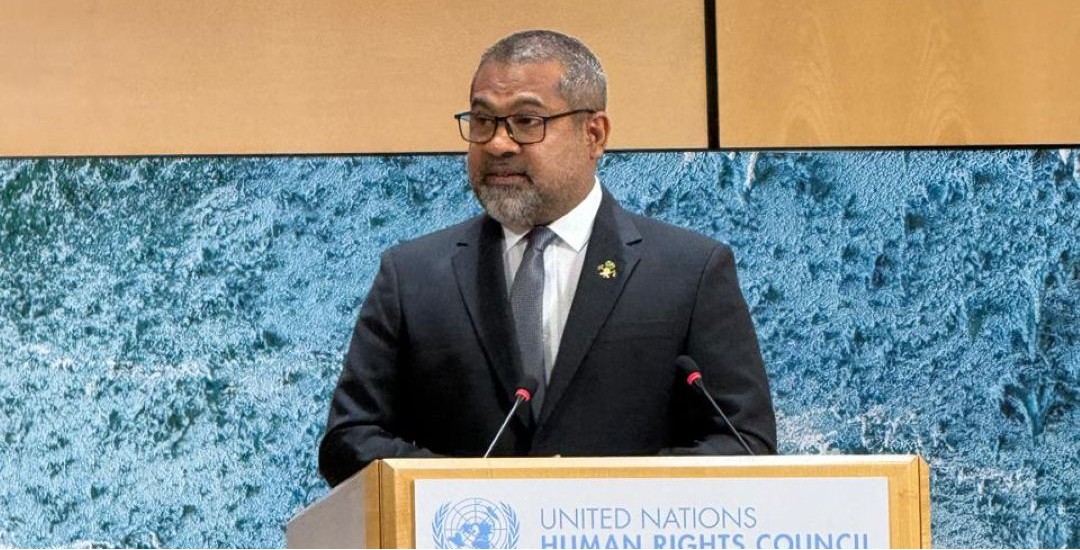
Mr. President,
Mr. High Commissioner,
Excellencies, Ladies, and Gentlemen.
It is an honour to address this Council for a second time.
When the Universal Declaration of Human Rights was adopted in December 1948, it did more than articulate ideals. It distilled centuries of human struggle into a simple principle that all human beings are born free and equal in dignity and rights.
Since then, the international community has built a remarkable legal architecture to protect that principle. Treaties were written. Institutions were created. Norms were agreed upon. And together, they form one of humanity’s most ambitious undertakings.
But progress does not move in a straight line.
The complexities of the modern world test not only our institutions, but our convictions. They compel us to ask whether the promises we made to one another and to future generations, are strong enough to withstand the pressures of rapid change, deepening inequality, and growing uncertainty.
For the Maldives, this much is clear.
The challenges may be new. The pace may be faster. The tools may be different. But the values upon which our success depends on are not. And it is through multilateralism that those values find meaning and purpose.
The Maldives is committed to the promotion and protection of human rights, both domestically and internationally. For us, it is an essential foundation for sustainable and inclusive development.
Domestically, we continue to strengthen democratic governance, the rule of law, and institutional accountability. Since the adoption of our 2008 Constitution, our democratic institutions have steadily matured through successive electoral cycles, with Presidential and Parliamentary elections widely recognised by international and domestic observers as peaceful, inclusive, and credible. Alongside this consolidation, broad legislative and institutional reforms have been undertaken to reinforce governance, combat corruption, expand labour protections, and strengthen access to justice.
These reforms include measures to enhance accountability within law enforcement and the justice sector, strengthen oversight mechanisms, and promote a rights-centred approach to public administration. Institutional capacity has been reinforced through legislative reform, professional training, and improved safeguards to ensure transparency, due process, and public trust.
We have prioritised inclusion and social equity. Women’s participation in local governance has increased substantially through electoral quotas, while targeted financial schemes support women entrepreneurs, including women with disabilities. National action plans guide reforms to advance the rights of persons with disabilities, strengthen child protection systems, and expand access to social services. Targeted programmes are being conducted for young people. We are expanding access to education, healthcare, and social welfare. These measures reflect our commitment to building an inclusive society grounded in dignity, opportunity, and equal protection under the law.
Internationally, the Maldives engages with the human rights system in the same constructive spirit. We recently concluded our fourth cycle of the Universal Periodic Review and continue active engagement with treaty bodies. We also maintain a standing invitation to all Special Procedures Mandate Holders and value their recommendations as an important contribution to our ongoing reform efforts.
Mr. President,
As a Small Island Developing State, the Maldives has consistently sought to champion an inclusive approach to human rights. One that recognises the particular challenges faced by Least Developed Countries and Small Island Developing States, and the importance of ensuring their meaningful and sustained participation in this Council. This conviction has guided our support for initiatives that address capacity constraints and enable LDCs and SIDS to engage fully and constructively in the Council’s work.
We have consistently called for accountability for human rights violations. Especially in Palestine, where Israel has repeatedly violated international law, threatened regional stability, destroyed civilian infrastructure, and undermined genuine hope for peace and progress. Despite repeated violations of international law, Israel continues to receive preferential trade treatment and arms transfers that fuel further aggression against the Palestinian people. We reaffirm our steadfast support for the legitimate rights of the Palestinian people, including their right to self-determination, and for an independent, sovereign State of Palestine established on the pre-1967 borders, with East Jerusalem as its capital. The State of Palestine must be admitted as a full member of the United Nations.
We believe that the integrity of the multilateral system depends on the collective commitment of all States – small and large - to uphold justice, inclusivity, and peace through the universal respect for human rights, without selectivity or exception.
Our most recent term on this Council, which concluded last year, reaffirmed our belief in the power of constructive engagement. Building on that experience, and guided by our continued commitment to universality, inclusion, dialogue and cooperation, the Maldives will be seeking election to the Human Rights Council for the term 2028-2030. We seek your support in these elections.
Mr. President,
As the international human rights landscape continues to evolve, this Council has a central responsibility to ensure that the system it stewards remains credible in its standards, inclusive in its processes, and effective in its impact.
The Maldives will continue to engage constructively and in good faith, working closely with the Office of the High Commissioner, Member States, and civil society, to strengthen implementation and cooperation where it matters most.
In doing so, we remain guided by the promise of the Universal Declaration of Human Rights; that human rights are universal, indivisible and inseparable from human dignity.
I thank you.